
How We Successfully Resolved a Google Merchant Center Misrepresentation Suspension – A Complete Case Study
Industry: Healthcare
Service Focus: Google Merchant Center
Introduction
Google Merchant Center (GMC) is one of the most powerful platforms for eCommerce businesses to showcase products across Google Shopping, Search, Images, YouTube, and other Google services. However, one of the most challenging issues merchants can face is an account suspension due to the Misrepresentation policy.
This case study explains how we helped our client, CibaFit, recover from a Google Merchant Center account suspension, restore product approvals, and successfully regain eligibility for Google Shopping listings.
The journey involved multiple reviews, detailed website audits, communication with Google Merchant Center Support, policy compliance improvements, and patience throughout Google’s review process.
Client Overview
CibaFit is an online health and wellness store built on Shopify, offering branded nutrition and wellness products from trusted manufacturers. The client wanted to use Google Merchant Center to enable YouTube Shopping, allowing approved products to be displayed and tagged on their YouTube channel.
Initially, the Merchant Center account was functioning normally. However, the account was later suspended due to Google’s Misrepresentation policy.
The Initial Suspension
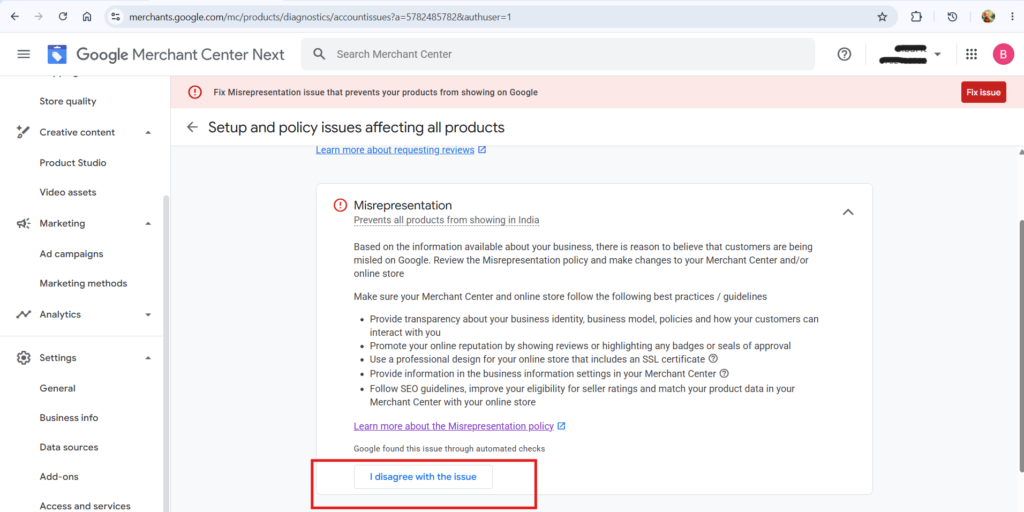
Without any major warning, Google Merchant Center suspended the account under the Misrepresentation policy.
As a result:
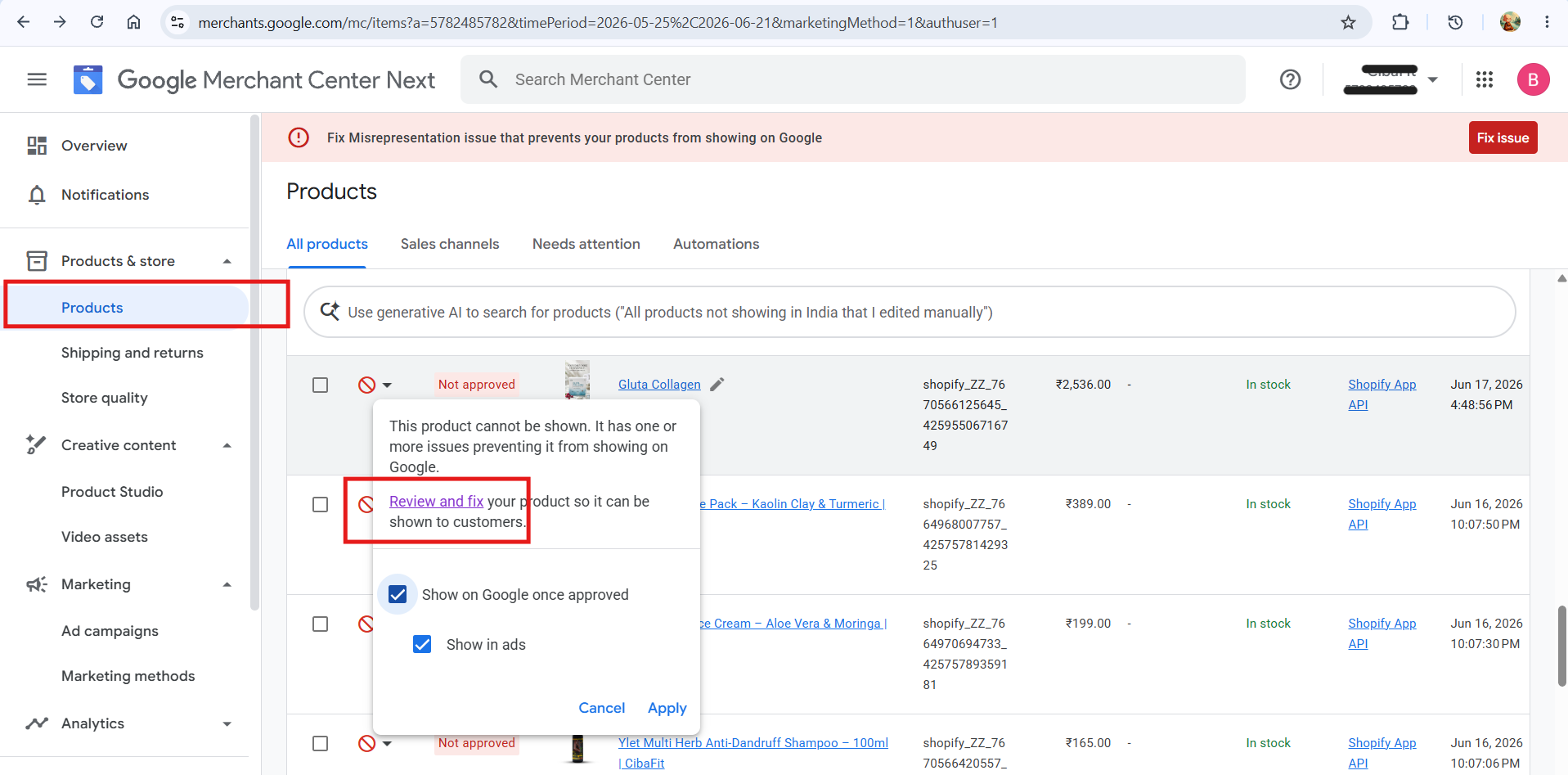
- Products stopped appearing on Google.
- Free Listings became inactive.
- Shopping Ads (if enabled) could not run.
- Google Shopping eligibility was removed.
- Merchant Center displayed an account-level suspension.
Although individual products were well structured, the account itself was considered non-compliant.
Understanding Google’s Misrepresentation Policy
Unlike product-specific policy violations, a Misrepresentation suspension is an account-level issue. Google evaluates the overall trustworthiness of a business rather than just the products it sells. This means that every aspect of the online store and business identity can influence the review process.
Google may evaluate:
- Business identity and legitimacy
- Website transparency
- Contact information
- Business address consistency
- Customer support details
- Refund, Shipping, Privacy and Terms policies
- Product information
- Brand authenticity
- Social proof and business presence
- Google Business Profile
- Website quality and user experience
Even small inconsistencies can contribute to a suspension.
Step 1 – Preparing a Detailed Compliance Checklist
Before making any changes, we created a comprehensive Merchant Center compliance checklist based on Google’s policies and best practices.
Rather than making random modifications, every potential trust signal was reviewed methodically. The checklist included:
- Business identity verification
- Website transparency
- Contact information
- Address consistency
- Phone number consistency
- Product data accuracy
- Business policies
- Brand information
- Social media presence
- Google Business Profile
- Shopify configuration
- Merchant Center settings
- Product feed quality
- Trust signals across the website
This checklist served as the roadmap for the entire recovery process.
Step 2 – Complete Website Audit
A detailed audit of the Shopify store was conducted to identify every possible issue that could affect Google’s trust evaluation.
Each page was carefully reviewed, including:
- Homepage
- About Us
- Contact Us
- Product pages
- Collection pages
- Checkout process
- Footer
- Policy pages
- Business information
Several areas requiring improvement were identified.
Step 3 – Correcting Business Information
One of the first improvements involved correcting inconsistencies in the business information.
Address Correction
A spelling mistake was identified in the business address. Although minor, consistency is critical for Google’s verification process.
The business address was corrected so that it matched across the following:
- Shopify Store
- Google Merchant Center
- Website Contact Page
- Business documentation
Phone Number Standardization
The business phone number was also reviewed.
Different formats and inconsistencies existed between the Shopify store and Merchant Center.
The phone number was standardised so that customers and Google would see the exact same contact information across all platforms.
Maintaining identical business information across every platform helps improve Google’s confidence in the legitimacy of the business.
Step 4 – Strengthening Website Trust Signals
Website Improvements
A number of trust-building improvements were implemented throughout the website.
These included:
1. About Us Page
The About Us page was rewritten to clearly explain:
- Company background
- Business purpose
- Customer commitment
- Product authenticity
- Brand relationships
The goal was to increase transparency and establish credibility.
2. Business Contact Information
The website was updated to ensure customers could easily find:
- Business address
- Contact number
- Email address
- Customer support information
3. Policy Pages
Each policy page was carefully reviewed and improved.
This included:
- Privacy Policy
- Shipping Policy
- Refund Policy
- Terms & Conditions
Every policy was made easily accessible from the website footer.
4. Product Information
Each product listing was reviewed for:
- Accurate titles
- Correct descriptions
- Brand consistency
- Pricing accuracy
- Product availability
- Image quality
5. Brand Authorization
One important aspect of this project involved clarifying the client’s relationship with the brands being sold.
Where applicable, the website included information indicating that products were sourced through authorised retail channels, helping improve transparency regarding product authenticity.
The objective was to provide customers—and Google’s review systems—with clear and transparent information about the business.
Step 5 – Building an Authentic Social Media Presence
During the audit, it was observed that the business had little or no active social media presence.
Although Google does not explicitly require social media accounts, consistent business profiles across reputable platforms strengthen online trust.
Official business profiles were created using the same:
- Business name
- Logo
- Contact number
- Business description
- Website URL
- Address (where applicable)
Profiles were created and optimised on relevant platforms such as Facebook, Instagram, and LinkedIn to establish a consistent digital identity.
Step 6 – Creating and Optimizing Google Business Profile
A Google Business Profile was created and optimised to further establish the business’s authenticity.
The profile included:
- Correct business name
- Verified address
- Contact number
- Website
- Business category
- Business description
- Operating hours
- Logo and business images
This ensured consistency between Google Business Profile, Shopify, Merchant Center, and the official website.
Step 7 – Reviewing Product Information
Every product listing was reviewed to ensure consistency and compliance.
This included:
- Product titles
- Descriptions
- Pricing
- Availability
- Images
- Brand information
- Product identifiers
Any inconsistencies between the website and Merchant Center feed were corrected.
Step 8 – Brand Transparency
The business sold products from established brands.
To improve transparency, the website clearly communicated that products were sourced through authorized retail channels wherever applicable.
This helped reinforce customer trust while providing additional clarity regarding product authenticity.
Step 9 – First Review Request
After completing all the required website and compliance improvements, we intended to request a review. However, the Merchant Center account did not provide a “Request Review” option and Google allows only a limited number of review requests, so we avoided using the “I Disagree with the Issue” option initially. Repeated unsuccessful review attempts can result in a longer cooldown period before another review is permitted, so we chose to work with Google Merchant Center Help & Support first.
Explained the issue in detail, and submitted the necessary screenshots and supporting information. Google acknowledged the case, initiated a manual review, and after the internal evaluation, the account suspension was lifted and the products were approved.
Temporary Success
Following the review:
- The Merchant Center suspension was removed.
- Products began receiving approval.
- Google Merchant Center indicated that products were eligible.
This suggested that the compliance improvements had addressed the issues identified during the review.
Unexpected Re-Suspension
A few days later, Google automatically suspended the Merchant Center account again under the same Misrepresentation policy.
This demonstrated that Google’s review process can involve multiple automated and manual evaluations, even after an account has been reinstated.
While frustrating, this did not necessarily indicate that previous improvements were ineffective.
Contacting Google Merchant Center Support
Instead of relying solely on the Help & Support system, we communicated directly with the Google Merchant Center support team through the existing support case, exchanging emails under the assigned case ID and requesting a manual review by a human support specialist.
A detailed explanation of the situation was provided, including:
- Previous suspension history
- Website improvements completed
- Brand authorization details
- Product authenticity information
- Timeline of the reinstatement and subsequent re-suspension
Supporting documentation and screenshots were also shared.
📧 No Review Button? No Problem.
“When the review button wasn’t available, one well-crafted email made all the difference. Sometimes, the path to resolving a Google Merchant Center suspension starts with the right conversation to the right team—not another click.”
Google’s Response
Google acknowledged the appeal and confirmed that the matter had been escalated for further internal investigation.
The response explained that Google’s review system evaluates multiple aspects of a merchant, including:
- Website
- Products
- Merchant Center account
- Other trust-related signals
Google also recommended submitting another review request through Merchant Center if the merchant believed the account complied with all applicable policies.
Although the response did not identify a specific policy trigger, it confirmed that the case was receiving additional attention.
The Final Review
After verifying that all compliance updates remained in place, another review was requested using the “I disagree with the issue” option available within Merchant Center.
This review initiated a fresh evaluation of the account.
Successful Resolution
Following Google’s review:
- The account suspension was lifted.
- Product approvals were restored.
- Merchant Center returned to good standing.
- Products became eligible to appear across Google surfaces again.
The issue was successfully resolved without creating a new Merchant Center account or migrating to a different eCommerce platform.
Outcome
By conducting a comprehensive website audit, strengthening trust signals, improving business transparency, communicating effectively with Google Merchant Center Support, and following Google’s review process, the CibaFit Merchant Center account was successfully restored.
The project demonstrates that even complex Misrepresentation suspensions can often be resolved through careful compliance work, accurate documentation, and persistence.
Need Help with Google Merchant Center?
If your Google Merchant Center account has been suspended due to Misrepresentation, Product Policy Violations, Website Trust Issues, or Account-Level Enforcement, professional guidance can significantly reduce the time required to identify compliance gaps and prepare a strong review request.
Every suspension is unique, but a systematic audit combined with policy-focused improvements can greatly improve the chances of a successful reinstatement.
Is your Google Merchant Center account suspended due to Misrepresentation, Product Policy Violations, or other account-level issues?
At GeeksGlobal Digital, we specialize in diagnosing Merchant Center compliance issues and helping businesses restore their product visibility through a structured, policy-focused approach.